Nairobi Travel Guide for First-Time Visitors
Plan your first Nairobi trip with practical advice on where to stay, getting around, food, wildlife, safety, best timing, and a simple itinerary.

Nairobi is not a soft landing in the polished, everything-is-walkable sense. It is a big, busy, traffic-heavy capital with excellent food, serious wildlife access, strong neighborhoods, and enough rough edges that your trip improves immediately when you stop pretending it is a simple safari waiting room.
That is the first useful Nairobi travel guide truth: treat the city as a destination with zones, not just a place to sleep before the Maasai Mara. The best first trip usually combines one wildlife morning, one city-and-food day, one Karen or Langata day, and a base that keeps you out of the worst traffic patterns.
_Nairobi feels like a real working capital first, then a safari gateway. That order matters when you plan the trip._
Quick Facts
- Best first-time base: Westlands for restaurants and convenience; Kilimani for calmer apartment and cafe stays; Karen/Langata for wildlife-focused plans.
- Best trip length: 3 full days for Nairobi itself, or 2 days if it is mainly a safari stopover.
- Best time: June to October and January to February are usually easiest for drier weather; March to May is wetter and often better value.
- Getting around: Use ride-hailing, hotel cars, or trusted drivers; plan days by zones because traffic can dominate.
- Biggest mistake: Booking far from your real priorities because the nightly rate looks better.
- Airport tip: Leave generous JKIA buffers because traffic can change the transfer completely.
Table of Contents
- 1.Is Nairobi worth visiting for first-time travelers?
- 2.Where should you stay in Nairobi the first time?
- 3.How should you get around Nairobi?
- 4.What should first-time visitors do in Nairobi?
- 5.Where should first-time visitors eat in Nairobi?
- 6.Is Nairobi safe for first-time visitors?
- 7.How many days do you need in Nairobi?
- 8.A simple 3-day Nairobi itinerary
- 9.When should you visit Nairobi for better value?
- 10.Common first-time Nairobi mistakes
- 11.Final take
Is Nairobi worth visiting for first-time travelers?
Nairobi is worth visiting if you want a city that adds context to a Kenya trip instead of just functioning as an airport transfer. It gives you wildlife, restaurants, museums, markets, leafy suburbs, and a modern African capital all in one place. That mix is the point.
> Quick answer: Nairobi is best for first-time visitors who want wildlife access, food, neighborhoods, and a practical base before or after safari. It is less ideal for travelers who want a slow, walkable city break with frictionless public transit.
The city is not always relaxing. Traffic can be brutal, neighborhood choice matters, and you need a little more situational awareness than in a tidy European weekend city. But Nairobi rewards travelers who plan by area and keep expectations realistic.
Do not skip Nairobi automatically because your safari operator says you can go straight through. One or two well-planned days can make the whole Kenya trip feel less like a wildlife package and more like an actual country.
Where should you stay in Nairobi the first time?
The best area to stay in Nairobi for most first-time visitors is Westlands, especially if you want restaurants, nightlife, malls, hotels, and easier access to several parts of the city. Kilimani is a good alternative for apartment stays and a calmer cafe-and-neighborhood feel. Karen or Langata makes sense if your Nairobi plan is built around wildlife attractions.
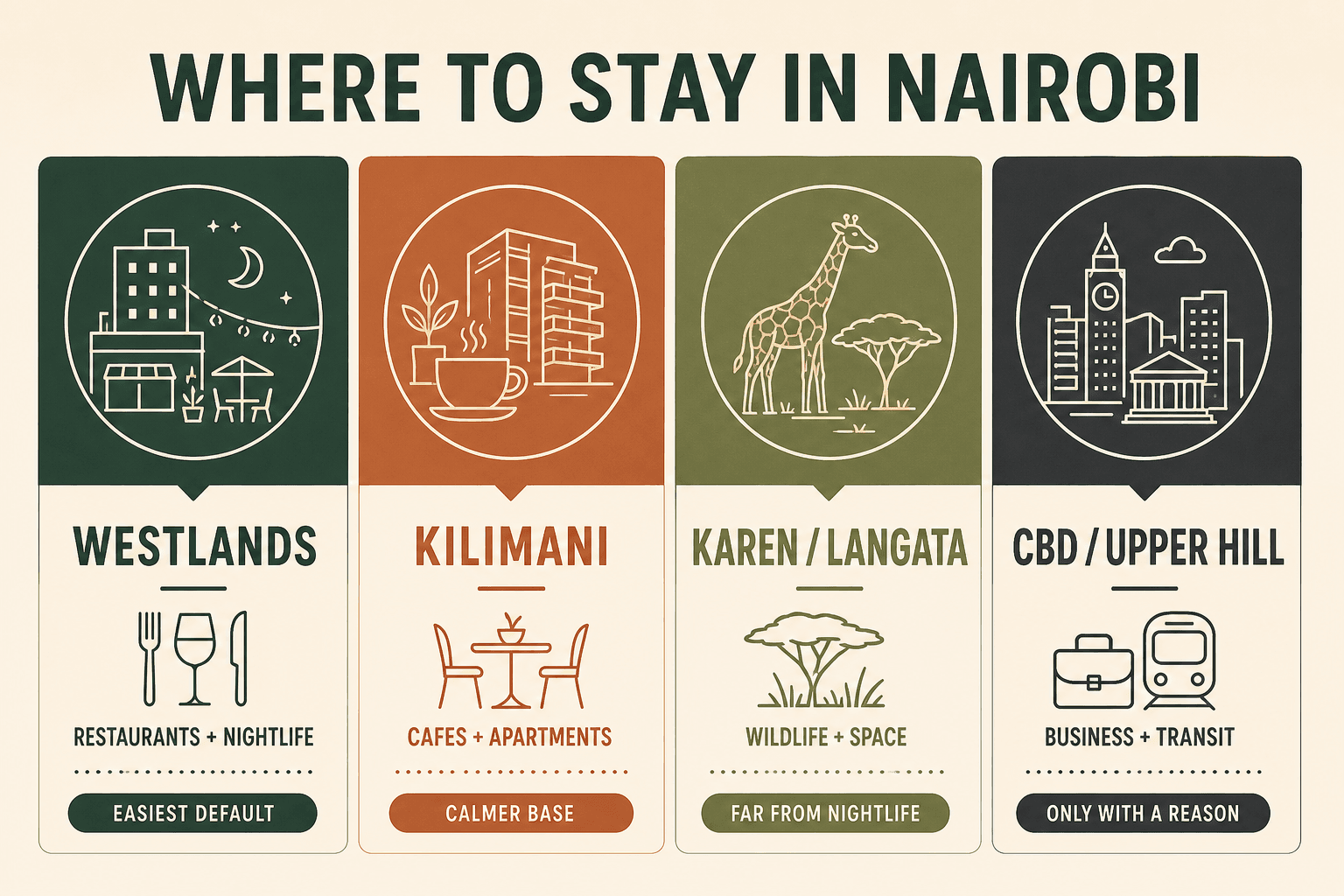
_Choose the base that matches the trip: Westlands is the easiest default, Kilimani is calmer, Karen and Langata suit wildlife plans, and the CBD or Upper Hill should solve a specific need._
Westlands
Westlands is the easiest default answer. It has strong hotel supply, plenty of restaurants and bars, modern shopping centers, and better practical range than many visitor zones. It works well if you want to be able to eat well without turning dinner into an expedition.
The tradeoff is that Westlands can feel more businesslike and less atmospheric than people imagine when they hear “Kenya.” That is not a failure. It is the price of convenience.
Kilimani and Lavington
Kilimani and nearby Lavington suit travelers who want serviced apartments, cafes, gyms, and a more residential version of Nairobi. This can be a smart base for longer stays or travelers who do not need a hotel-heavy district.
The caution is that movement still depends on cars. A place can look close to everything and still be annoying once traffic joins the conversation, as traffic loves ruining maps for sport.
Karen and Langata
Karen and Langata are best if your Nairobi trip is focused on the Giraffe Centre, Sheldrick Wildlife Trust, Nairobi National Park access, Karen Blixen Museum, or quieter leafy stays. This area feels more spacious and can be excellent for families or safari-adjacent travelers.
The downside is distance from central nightlife, Westlands restaurants, and some business areas. If you want urban Nairobi, do not accidentally book a retreat-style stay and then complain that the city feels far away. It is.
CBD and Upper Hill
The CBD can be useful for specific work, transport, or budget reasons, but it is not my first recommendation for most first-time leisure travelers. It is busy, practical, and not the easiest base after dark. Upper Hill is more business-oriented and can work for corporate stays, but it is not the most natural visitor neighborhood.
For most travelers, Westlands, Kilimani, or Karen/Langata will create a smoother first trip.
How should you get around Nairobi?
The easiest way for first-time visitors to get around Nairobi is ride-hailing or a trusted driver, with days grouped by neighborhood. Nairobi is not a city where you should plan on casual cross-town wandering between attractions just because they look close on a map.

_Traffic is the hidden itinerary tax in Nairobi; build days by zones, not wishful thinking._
Uber, Bolt, Little Cab, hotel cars, and pre-arranged drivers are the practical tools. Use them especially at night, for airport transfers, and for any route where you do not know the neighborhood well. Matatus are part of Nairobi life and can be cheap and lively, but they are not the low-friction default for most first-time visitors carrying bags or trying to keep a schedule.
The most important transport advice is to plan in clusters. Do Karen/Langata sights together. Do Westlands and nearby food or nightlife together. Put Nairobi National Park on an early morning plan. Do not build a day that zigzags from Karen to CBD to Westlands to the airport unless you enjoy watching brake lights as a hobby.
For JKIA airport transfers, leave generous buffers. The airport is not impossibly far, but traffic can turn a normal drive into a stress seminar. If you have an international flight, boringly early is better than heroically late.
> Quick answer: Use ride-hailing or a trusted driver, group sights by area, and treat traffic as a fixed planning constraint rather than a surprise.
What should first-time visitors do in Nairobi?
The strongest first-time Nairobi plan should include one wildlife anchor, one neighborhood-and-food day, and one cultural or market stop. Do not try to see every museum, every animal experience, every shopping stop, and every restaurant in two days. Nairobi is better when the itinerary has shape.

_Nairobi National Park is the rare first-day wildlife option that does not require leaving the capital._
Nairobi National Park
Nairobi National Park is the headline because it is genuinely unusual: wildlife at the edge of a major capital. Go early. Morning gives you better conditions, better odds, and a cleaner schedule before traffic and heat start bullying the day.
This is not a replacement for a full safari in the Mara, Amboseli, or Laikipia. Think of it as a remarkable city-adjacent wildlife experience, not the entire Kenya safari condensed into one morning. That framing keeps expectations sane.
Giraffe Centre and Sheldrick Wildlife Trust
Giraffe Centre is easy to understand and easy to pair with Karen/Langata plans. Sheldrick Wildlife Trust is more schedule-sensitive and should be booked or checked ahead because public visiting windows and availability matter. Do not assume you can casually show up because a blog from 2018 made it sound easy. Travel content ages like milk in the sun.
Pair these with Karen Blixen Museum or a relaxed lunch in Karen if you want that part of the city to feel like a proper day rather than a taxi relay.
Nairobi National Museum, markets, and city context
Nairobi National Museum gives useful context if you want history and culture before heading deeper into Kenya. Maasai Market can be worthwhile if you want crafts and souvenirs, but locations rotate by day and bargaining is part of the experience. Check the current location before going.
Karura Forest is a strong break from traffic and concrete if you want walking, greenery, and a calmer Nairobi rhythm. It is especially useful if you are staying in or near the northern side of the city.
Where should first-time visitors eat in Nairobi?
Nairobi food planning works best by area: Westlands for range, Kilimani for cafes and casual dining, Karen for slower lunches, and local nyama choma or Kenyan meals when you want the trip to taste like somewhere specific. Chasing one famous restaurant across town at rush hour is usually bad math.

_Food works better when you plan by area instead of chasing one famous restaurant across traffic._
For a first trip, build food around your actual route. If you are in Westlands, lean into the district’s restaurants, bars, and hotel-adjacent convenience. If you are in Kilimani, use the cafe scene and casual restaurants. If you are in Karen, make lunch part of the area day rather than racing back across town.
Try Kenyan food intentionally, not as an obligation squeezed between international restaurants. Nyama choma, sukuma wiki, ugali, samosas, grilled meats, stews, tea, and local breakfast or lunch plates can all be part of the trip if you leave room for them. Nairobi also has strong Indian, Ethiopian, and modern global dining, which reflects the city better than a single “must eat” checklist ever will.
Street food and markets can be enjoyable, but use judgment. Pick busy places, watch hygiene, and do not make your first experiment five minutes before a long transfer. Food poisoning is the worst kind of immersive travel.
> Quick answer: Eat by neighborhood, plan one Kenyan meal, one nicer Westlands or Kilimani dinner, and one relaxed Karen or cafe lunch if your route supports it.
Is Nairobi safe for first-time visitors?
Nairobi is manageable for first-time visitors who use normal big-city caution, but it is not a place to be careless with phones, jewelry, late-night walking, or unfamiliar streets. The goal is not paranoia. The goal is to avoid being the easiest target in the area.
Use ride-hailing or trusted transport after dark. Keep your phone controlled near traffic and open windows. Avoid flashing valuables. Ask your hotel or host for current neighborhood-specific advice. Be careful around ATMs. Do not wander through quiet or unfamiliar areas at night because the map says your destination is only 14 minutes away.
For documents and entry rules, check Kenya’s current electronic travel authorization requirements before departure. Rules change, and nothing says “great vacation energy” like discovering paperwork drama at the airport.
Health-wise, carry any medication you need, drink safe water, and ask a travel clinic about vaccines or malaria advice based on your wider Kenya itinerary. Nairobi itself is only one part of the risk picture; safari areas and onward destinations can change the advice.
How many days do you need in Nairobi?
Most first-time visitors need 2 to 3 days in Nairobi. Two days works if the city is a stopover before safari. Three days is better if you want Nairobi National Park, Karen/Langata, food, museums, and a bit of neighborhood feel without rushing.
A one-night transit stop is functional, but it does not really let Nairobi make a case for itself. If you land late, sleep, and leave at dawn, you visited an airport with extra paperwork. That is sometimes necessary, but it is not a Nairobi trip.
Four days makes sense if you are working remotely, recovering from long flights, visiting friends, or using Nairobi as a base between safari legs. For pure leisure, three well-built days are usually enough before the city starts competing with the rest of Kenya for attention.
> Quick answer: Plan 3 full days if Nairobi is part of the trip, or 2 days if it is mainly a pre-safari or post-safari stop.
A simple 3-day Nairobi itinerary
A good first Nairobi itinerary keeps each day geographically honest. The whole point is to reduce cross-town friction and give the city enough room to work.
Day 1: Arrive, settle in, and use Westlands or Kilimani
Stay close to your base on arrival day unless you land early and feel sharp. Use the day for a relaxed meal, SIM or eSIM setup, cash/card basics, and a low-pressure neighborhood dinner. If you are staying in Westlands or Kilimani, this is a good night to keep things easy.
Day 2: Nairobi National Park and city context
Start early with Nairobi National Park. Afterward, return for rest, then choose either Nairobi National Museum, Karura Forest, or a Westlands/Kilimani food plan depending on energy. Do not stack too much after the park morning. Early starts have a way of making afternoon ambition look stupid.
Day 3: Karen and Langata
Use this day for Giraffe Centre, Sheldrick Wildlife Trust if scheduled, Karen Blixen Museum if it interests you, and a slow lunch in Karen. This is the day where a driver or well-planned ride-hailing sequence pays off.
If you have an extra half-day, add Maasai Market if the location works, or use the time for a calmer cafe and shopping stop. Nairobi does not need to be conquered. It needs to be sequenced.
When should you visit Nairobi for better value?
The best Nairobi weather windows are usually the drier periods from June to October and January to February, but the best value often sits around the edges when demand softens and hotels have more room to breathe. March to May can be wetter, which may lower rates but also makes some plans less pleasant.
If Nairobi is attached to a safari, your timing should be driven by the full Kenya route, not Nairobi alone. Great hotel value in the city does not matter much if the wildlife region you care about is in the wrong season for your priorities.
Book earlier around peak safari periods, major holidays, and conference-heavy dates. Nairobi is a business and NGO hub as well as a travel stop, so hotel pricing can move for reasons that have nothing to do with vacation logic. Cities love making simple things weird.
For most first-time travelers, the smart move is to pick the Kenya season first, then choose a Nairobi base that reduces friction. A cheaper hotel on the wrong side of your plans is not value. It is a discount on inconvenience.
Common first-time Nairobi mistakes
The biggest Nairobi mistake is treating distance as the main planning variable. Time matters more than miles. Traffic, route quality, security comfort, and the time of day all affect whether a plan feels smooth or miserable.
The second mistake is picking the wrong base. A beautiful hotel far from your actual priorities can quietly damage every day. Choose Westlands, Kilimani, Karen/Langata, or another area because it fits the trip, not because a booking site sorted by discount.
The third mistake is overloading the itinerary before or after safari. Nairobi is rewarding, but it is still a large city with logistics. Keep the plan tight, practical, and zone-based, and the city becomes much easier to like.
Final take
Nairobi is a strong first stop in Kenya when you give it a practical plan. Stay in an area that matches your priorities, use cars intelligently, wake up early for wildlife, eat by neighborhood, and leave the city with a little more context than you arrived with.
That is the version of Nairobi worth building into a first trip: not a generic capital, not a safari footnote, and definitely not a walkable little weekend toy. It is a real city. Plan like it.
Let Fare Window find the best fares for your next trip.
Track routes, watch price changes, and get smarter alerts before you book.
Start tracking faresKeep planning
Related travel guides
Explore more first-time destination guides while you compare routes, seasons, and trip shapes.